Shopping Cart
Your cart is empty.
$0.00
View Cart
Choosing between a real Christmas tree and an artificial Christmas tree is one of the most common holiday decisions families make. Some people love the convenience of pulling the same artificial tree out of storage every year. Others believe nothing can replace the fragrance, beauty, and tradition of a fresh real Christmas tree.
There is not one perfect answer for every family. The best choice depends on your home, your schedule, your decorating style, your budget, and what Christmas traditions matter most to you.
Still, if you are comparing real vs. artificial Christmas trees, there are several important differences to consider. From fragrance and appearance to environmental impact and family memories, each option offers a very different holiday experience.
At Brown’s Tree Farm, we are naturally partial to real Christmas trees. But we also understand that families want practical answers. This guide will help you compare both options so you can choose the tree that feels right for your home.
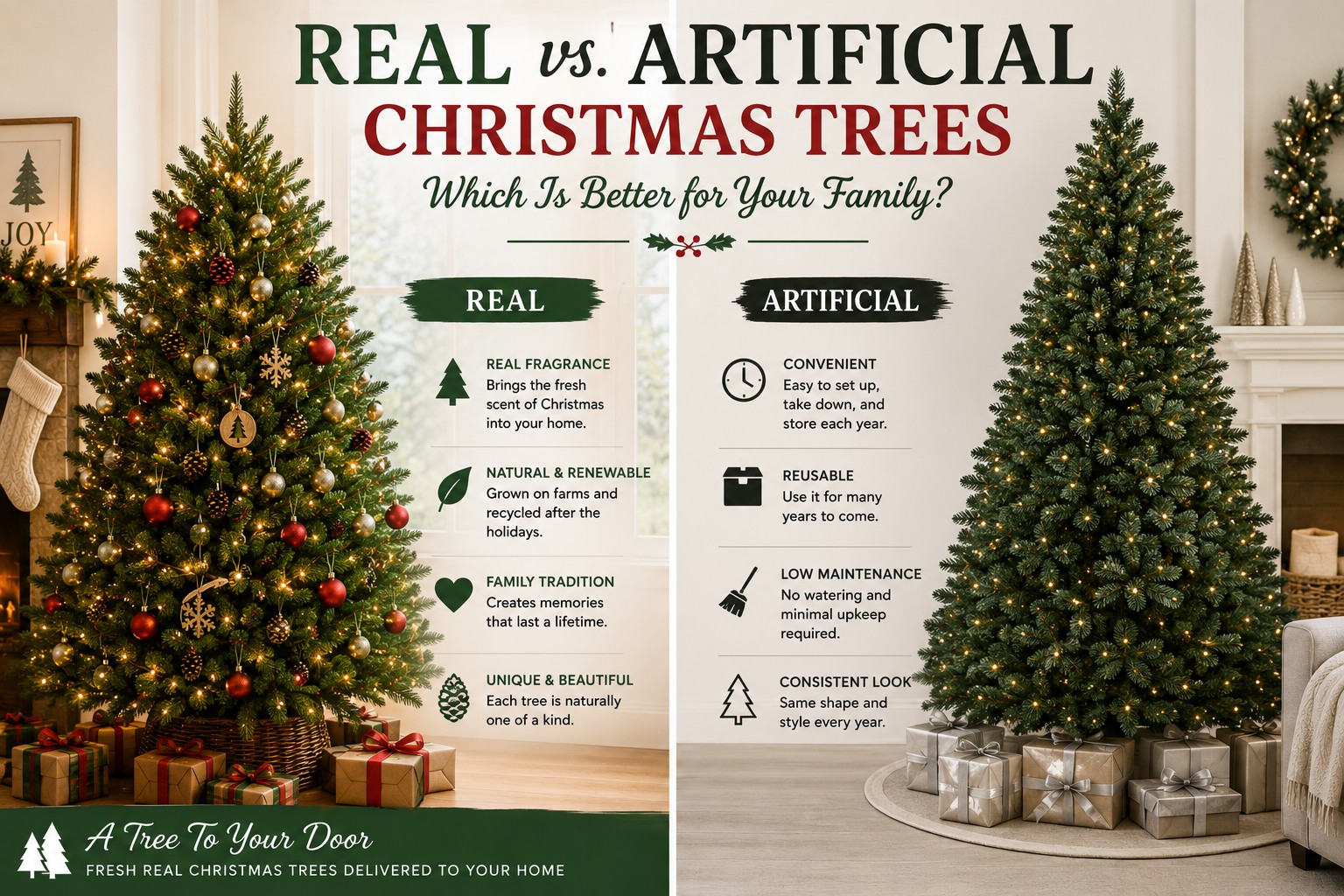
For many families, the biggest reason to choose a real Christmas tree is simple: it feels like Christmas.
A real tree brings natural fragrance, texture, color, and character into your home. Every tree is slightly different. The branches, shape, fullness, and scent all help create a holiday centerpiece that feels authentic and memorable.
Artificial trees can look nice, especially high-quality ones, but they do not offer the same natural experience. They do not have the fresh evergreen scent of a Fraser Fir or Balsam Fir. They do not change from year to year. They do not create the same connection to the season, the farm, or the tradition of bringing a fresh tree into the house.
For some families, that tradition is the whole point.
One of the biggest advantages of a real Christmas tree is fragrance.
The scent of a fresh tree can fill a room and become one of the most memorable parts of the holiday season. Balsam Fir is especially known for its classic Christmas tree fragrance. Fraser Fir has a pleasant evergreen scent that many families love. White Pine has a softer, lighter presence with very little aroma, which can be helpful for families who prefer a lower-fragrance tree.
Artificial trees may look realistic, but they cannot naturally create that fresh evergreen smell. Some families use candles, sprays, or scented ornaments to imitate the scent, but it is not quite the same as having a real tree in the room.
If fragrance is important to your family, a real Christmas tree is usually the better choice.
The strongest argument for an artificial Christmas tree is convenience.
An artificial tree can be stored and reused year after year. You do not need to water it. You do not need to make a fresh cut. You do not need to worry about needle drop. Many artificial trees are pre-lit, which can make decorating faster.
For families who travel often, decorate very early, have limited access to fresh trees, or simply want the easiest setup, an artificial tree may be practical.
However, convenience is not the only factor. Artificial trees still require storage space, assembly, fluffing, and eventual replacement. Pre-lit trees can also become frustrating if sections of lights stop working.
Artificial trees are convenient, but they are not completely maintenance-free.
Real Christmas trees are grown by farmers (like us here at Brown’s Tree Farm). They are not simply cut from forests and removed without replacement.
Christmas tree farms plant, grow, shape, harvest, and replant trees as part of an agricultural cycle. Many real Christmas trees take years to grow before they are ready for a family’s home. During that time, the trees are part of working farmland and open green space.
When you buy a real Christmas tree, you are supporting growers, farm workers, local businesses, trucking companies, suppliers, and rural communities. For many families, that matters.
At Brown’s Tree Farm, every tree we ship represents years of work before it ever reaches a customer’s home. Buying a real tree helps support family farms and keeps a long-standing holiday tradition alive.
Many people assume that using the same artificial tree every year must automatically be better for the environment. The reality is more complicated.
Real Christmas trees are renewable and recyclable. They are grown on farms, harvested, and replaced with new seedlings. During their growing years, Christmas trees provide green space and can support soil, air, water, and wildlife benefits.
Artificial trees are reusable, but they are commonly made from plastic and metal. They also require manufacturing, packaging, shipping, storage, and eventual disposal. Since artificial trees are not biodegradable in the same way real trees are, they usually end up in landfills when they are no longer used.
If a family already owns an artificial tree and uses it for many years, that can help spread out its environmental impact. But if you are choosing between buying a new artificial tree and buying a farm-grown real tree, a real tree is often the more natural and renewable choice.
A real Christmas tree does not have to go to waste after the holiday season.
Many communities offer Christmas tree recycling programs. Trees may be chipped into mulch, used for erosion control, placed in natural areas for habitat, or reused in other environmentally helpful ways depending on the local program.
This is one of the biggest advantages of a real tree. After bringing beauty and joy into your home, the tree can still serve another purpose.
Artificial trees are different. Once they are worn out, broken, faded, or no longer wanted, they are much harder to recycle because they are usually made from mixed materials such as plastic, wire, and metal.
The cost comparison between real and artificial Christmas trees depends on how you look at it.
A real Christmas tree is purchased each season. That means the cost repeats every year, but you are also getting a fresh, natural tree each year.
An artificial tree usually costs more upfront, but it can be reused for multiple seasons. Over time, the yearly cost may be lower if the tree lasts a long time and your family continues to use it.
However, cost is not just about the purchase price. You should also consider storage space, replacement lights, broken sections, and whether your family still likes the tree after several years.
For many families, buying a fresh real tree each year is part of the holiday tradition, not just a decoration expense.
Artificial trees are designed to look consistent. They are usually symmetrical, evenly spaced, and available in many styles. Some families like that polished appearance.
Real Christmas trees have natural character. One tree may be slightly fuller. Another may have a unique branch pattern. Some have open spaces that are perfect for ornaments. Others have a dense, classic shape.
That natural variation is part of the charm. A real tree does not look manufactured. It looks alive, fresh, and connected to the season.
If your family wants a perfectly uniform tree, artificial may be appealing. If you want natural beauty and character, a real Christmas tree is hard to beat.
A real Christmas tree does require care.
You need to make a fresh cut from the bottom of the trunk, place the tree in water, check the water level daily, and keep the tree away from heat sources. These steps are simple, but they do matter.
An artificial tree does not need water, but it still requires assembly, fluffing, storage, cleaning, and careful handling. If it is pre-lit, the lights may also require troubleshooting over time.
So the question is not really whether one tree requires care and the other does not. The better question is which type of care your family prefers.
Some people enjoy caring for a real tree because it feels like part of the holiday season. Others prefer the simplicity of an artificial tree.
View our Real Christmas Tree Care page for additional tree care tips.
Both real and artificial Christmas trees should be used safely.
With a real tree, freshness and water are important. A well-watered tree kept away from heat sources is the best approach. You should also use safe lights, inspect cords, and turn lights off when you leave home or go to bed.
With an artificial tree, you should also inspect lights, cords, and connections. If the tree is older, check for wear, broken pieces, or damaged wiring.
No matter which type of tree you choose, safe decorating habits matter.
For many families with children, a real Christmas tree creates memories.
Kids remember choosing the tree, smelling the tree, helping water it, hanging ornaments, and watching it become the center of the room. A real tree can make the holiday feel more special because it changes each year and becomes part of the season’s story.
Artificial trees can also be part of family tradition, especially if your family decorates the same tree together every year. The right choice depends on what kind of memories you want to create.
If your goal is tradition, fragrance, and a more natural Christmas experience, a real tree is a wonderful choice.
If convenience is the top priority, artificial trees have advantages. They can be stored at home, reused, and set up without watering.
But buying a real Christmas tree has become much more convenient than it used to be. You no longer have to visit a crowded tree lot, tie a tree to your vehicle, or drag it home yourself.
With A Tree To Your Door, you can choose your real Christmas tree online, select your preferred shipping week, and have it delivered to your home. That gives families the experience of a real tree with much less hassle.
For many customers, home delivery makes a real Christmas tree much easier to enjoy.
If you decide that a real tree is best for your family, the next step is choosing the right variety.
Fraser Fir is one of the best all-around Christmas trees. It has excellent needle retention, strong branches, soft needles, a beautiful shape, and a pleasant fragrance.
Balsam Fir is a great choice if fragrance is your top priority. It has the classic Christmas tree scent many families love.
White Pine is a good option if you want soft needles, a full appearance, and very little fragrance. It works best with lights, ribbon, and lightweight ornaments.
Each variety offers a different holiday experience, so the best tree depends on your family’s decorating style and preferences.
Even though we love real Christmas trees, there are situations where an artificial tree may make sense.
An artificial tree may be better if you:
If an artificial tree works best for your family, that is okay. Christmas is about creating joy in your home.
But if you want natural fragrance, tradition, beauty, and the experience of a fresh tree, a real Christmas tree is a special choice.
Real Christmas trees remain popular because they offer something artificial trees cannot fully duplicate.
They smell fresh. They look natural. They support farmers. They are renewable and recyclable. They create family memories. They make the season feel alive.
A real tree is not just a decoration. It is part of the holiday experience.
From the moment it arrives to the moment the lights are added, a real Christmas tree can make your home feel warmer, more festive, and more connected to tradition.
So, which is better: real or artificial Christmas trees?
If your top priorities are storage, reuse, and low day-to-day care, an artificial tree may be the practical choice.
If your top priorities are fragrance, natural beauty, tradition, supporting farmers, and creating a memorable family experience, a real Christmas tree is hard to beat.
For many families, the better choice is a farm-grown real Christmas tree. And with online ordering and home delivery, enjoying a fresh real tree is now more convenient than ever.
A Tree To Your Door makes it easy to enjoy the tradition of a fresh real Christmas tree without the hassle of hauling one home yourself.
Brown’s Tree Farm ships fresh real Christmas trees directly to customers, allowing you to choose the variety, size, and shipping week that works best for your family.
Whether you choose Fraser Fir, Balsam Fir, or White Pine, a real Christmas tree can bring natural beauty, fragrance, and tradition into your home this holiday season.
Real Christmas trees are better for families who value fragrance, natural beauty, tradition, and supporting farm-grown products. Artificial trees may be better for families who prioritize reuse, storage, and low daily maintenance.
Real Christmas trees are farm-grown, renewable, and recyclable. When they are properly recycled after the holidays, they can be turned into mulch or reused in other helpful ways.
Artificial trees can be reused for many years, but they are usually made from plastic and metal and are difficult to recycle at the end of their life. Their environmental impact depends partly on how long they are used.
A real Christmas tree smells better because it naturally gives off a fresh evergreen fragrance. Artificial trees do not naturally provide that scent.
A real Christmas tree is not hard to care for, but it does need water. Make a fresh cut, place it in a sturdy stand, check the water daily, and keep it away from heat sources.
Fraser Fir is one of the best real Christmas trees for families because it has excellent needle retention, strong branches, soft needles, and a pleasant fragrance. Balsam Fir is best for stronger fragrance, while White Pine is best for soft needles and lighter decorations.
Yes. A Tree To Your Door allows you to buy a real Christmas tree online and have it delivered directly from Brown’s Tree Farm to your home.
For many families, yes. A real Christmas tree is worth it because it brings natural fragrance, beauty, tradition, and a memorable holiday experience into the home.
Want more information about REAL Christmas Trees? Click here to visit the National Christmas Tree Association’s website.